Mobility-informed infrastructure planning
The demand for infrastructure like transportation, energy, and water highly depends on the spatial and temporal presence of people. Our research uses high-resolution, dynamic mobility flow predictions to improve infrastructure demand forecasts - particularly for energy systems. This enables both real-time operational support and long-term planning, particularly under stress conditions such as extreme heat.
Highlights:
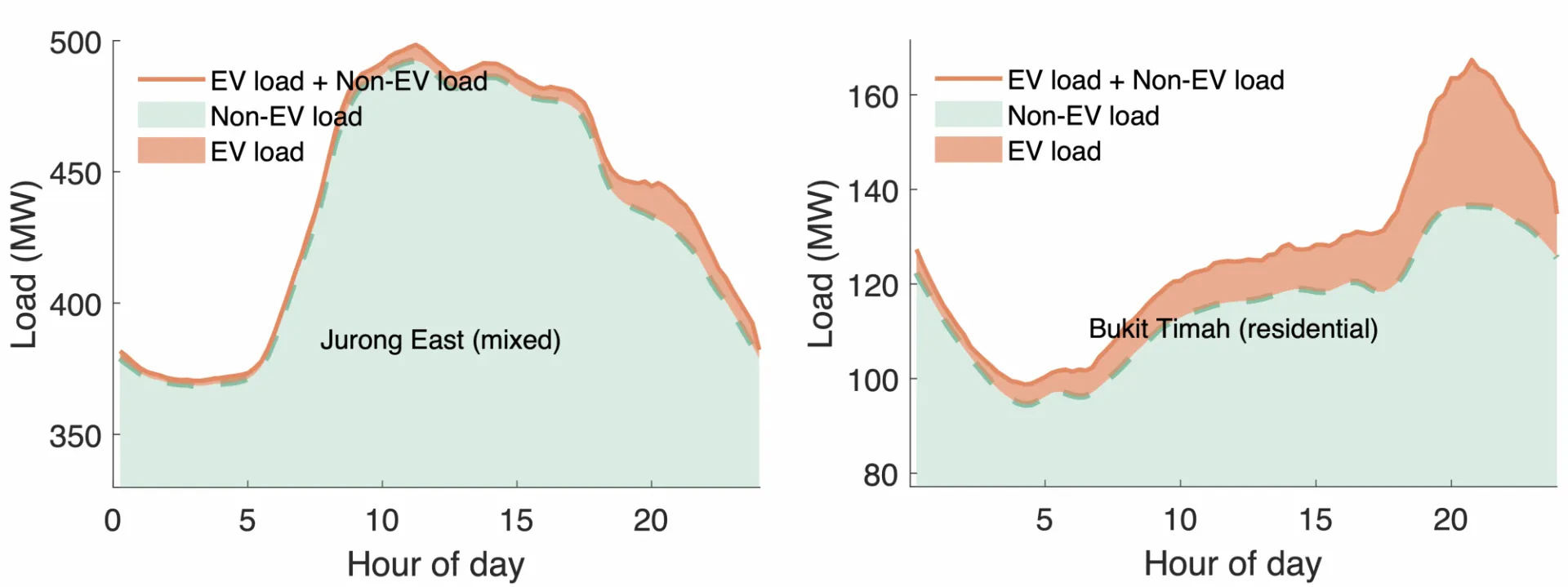
New electricity demands from electric vehicle (EV) charging introduce significant challenges to the power supply infrastructure. This work introduces a methodology for modeling the spatial-temporal EV charging demand by leveraging mobility data. The detailed individual mobility patterns extracted from these data enable the simulation of district-level EV charging demand profiles, helping to identify critical areas that require grid expansion to accommodate this new demand.
Jiazu Zhou, Seanglidet Yean, Tianyu Dong, Bu Sung Lee, and Markus Schläpfer, Estimating Electric Vehicle Charging Demand and its Impact on the Power Grid Using Mobile Phone Data, International Conference on Intelligent Transportation (2024). Best application paper award! [link]
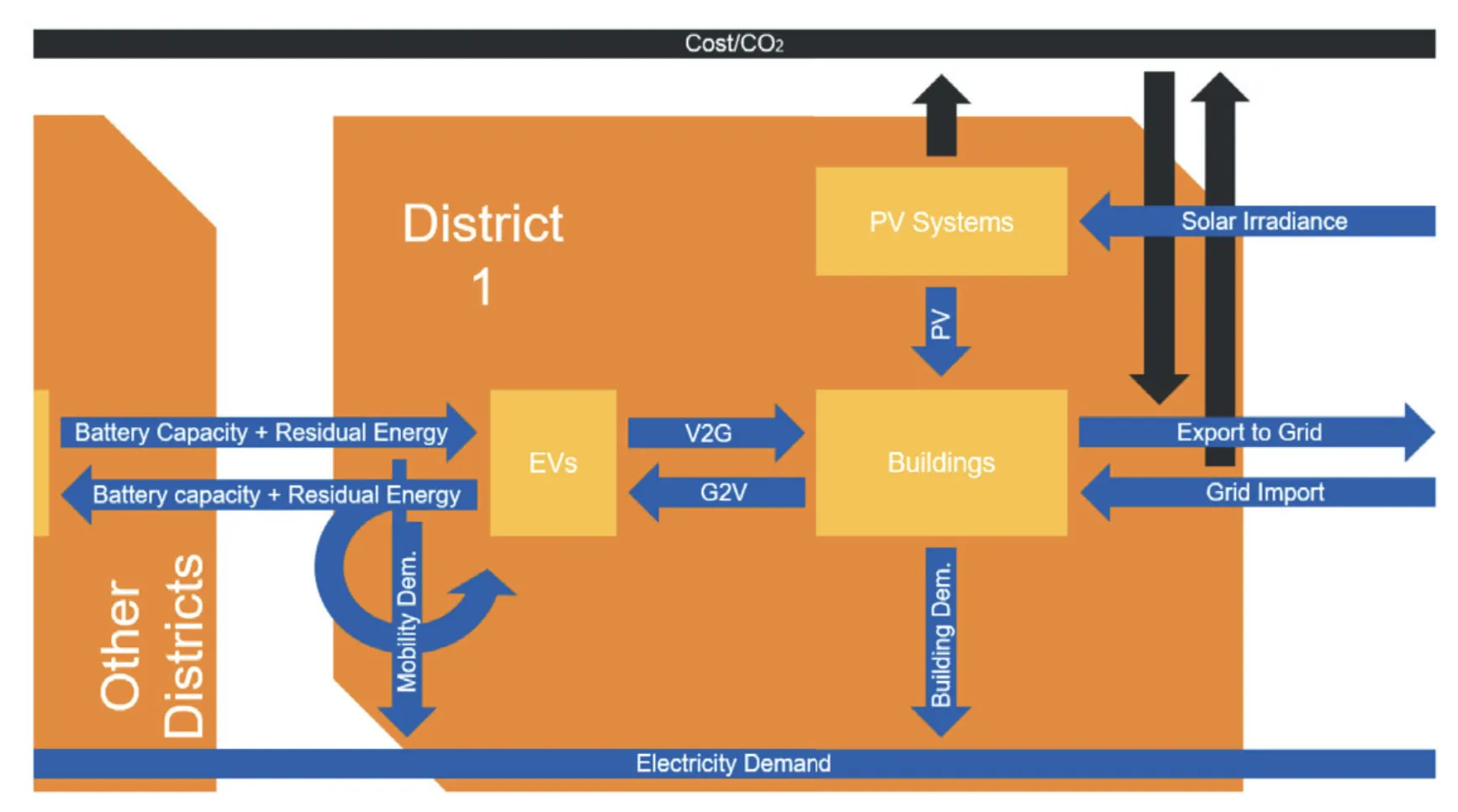
This work investigates the potential of building-integrated photovoltaic (BIPV) and vehicle-to-grid (V2G) coupling for the city of Singapore. Using the city’s 55 planning areas as spatial units, a linear programming (LP) optimization model is developed to determine economically optimal PV scaling and (dis)charging strategies. Mobility flows between planning areas are assessed using a large set of GPS mobile phone records, from which electric vehicle (EV) schedules are derived.
Dominic Caviezel, Christoph Waibel, Markus Schläpfer and Arno Schlueter, Vehicle-to-Grid Coupled Photovoltaic Optimization for
Singapore at a District Resolution, Proceedings of the 36th International Conference on Efficiency, Cost, Optimization, Simulation and Environmental Impact of Energy Systems, 25–30 June 2023, Las Palmas de Gran Canaria, Spain. [link]