Predicting mobility flows with urban science and artificial intelligence
Human mobility is not only at the heart of the economic functioning of cities, but it also shapes the demand for infrastructure services. Our goal is to understand and predict people's city-wide mobility patterns and how they affect and are affected by changes in urban infrastructures. To achieve this goal, we combine urban science with artificial intelligence.
Highlights:
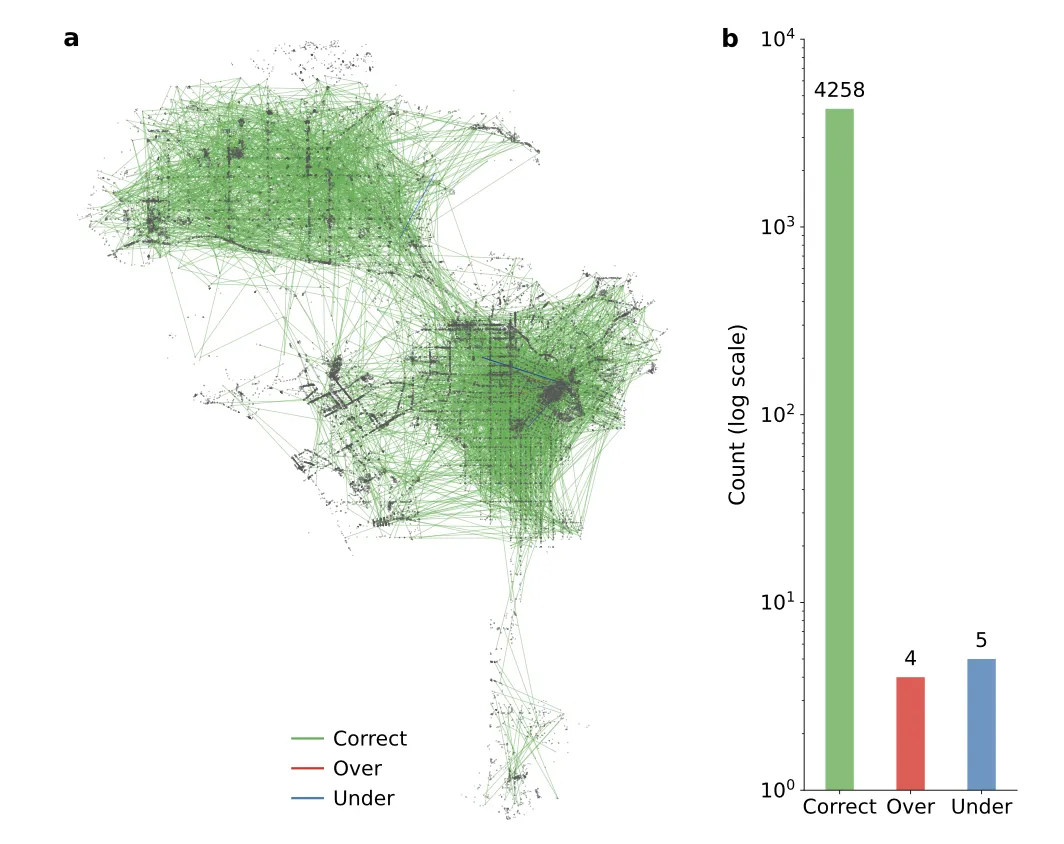
Accurate prediction of population flows is crucial for urban planning, yet current methods face major limitations: traditional models rely on static assumptions, deep learning struggles with generalization, and LLMs are computationally intensive and spatially naive. UrbanPulse addresses these gaps with a scalable deep learning framework that treats each POI as a node, combining graph and transformer architectures to capture fine-grained, city-wide mobility patterns. Using a three-stage transfer learning strategy and 103 million GPS records from California, it achieves state-of-the-art accuracy while enabling practical, high-resolution forecasting across diverse urban contexts.
Hongrong Yang and Markus Schläpfer, UrbanPulse: A Cross-City Deep Learning Framework for Ultra-Fine-Grained Population Transfer Prediction, arXiv preprint arXiv:2507.17924 (2025). [link]
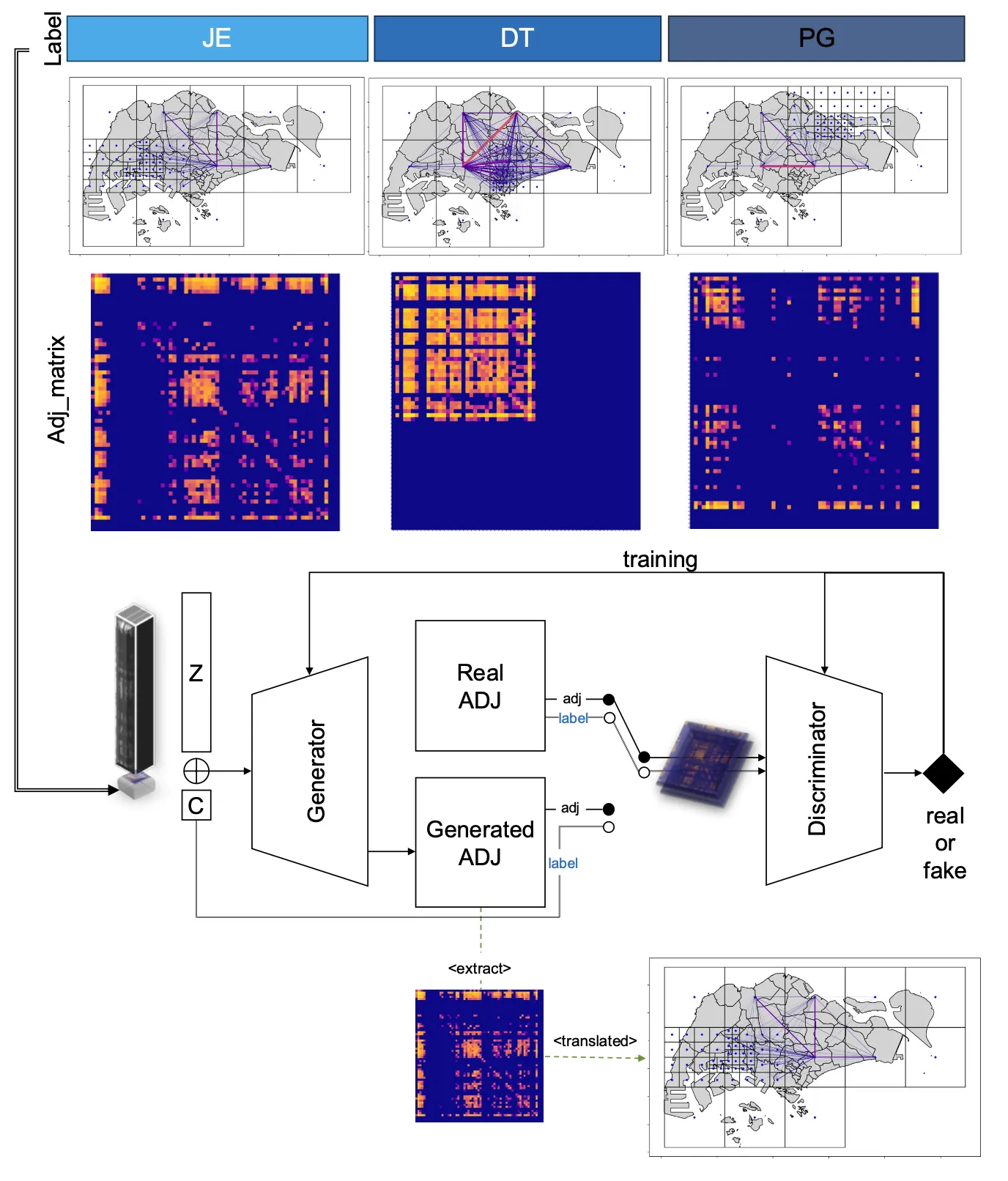
As cities evolve, so do mobility patterns—making it essential for planners to simulate future flows under changing land use and population. Existing models often rely on static assumptions or historical data, limiting their predictive power. This study introduces a data-driven approach using conditional GANs to generate origin-destination flows based on adaptive region sizes and land use archetypes. It enables fast, fine-grained mobility predictions without extensive calibration, and outperforms existing methods in tests on mobile phone data from Singapore.
Seanglidet Yean, Jiazu Zhou, Bu-Sung Lee, Markus Schläpfer, FloGAN: Scenario-Based Urban Mobility Flow Generation via Conditional GANs and Dynamic Region Decoupling, arXiv preprint arXiv:2507.12053 (2025). [link]
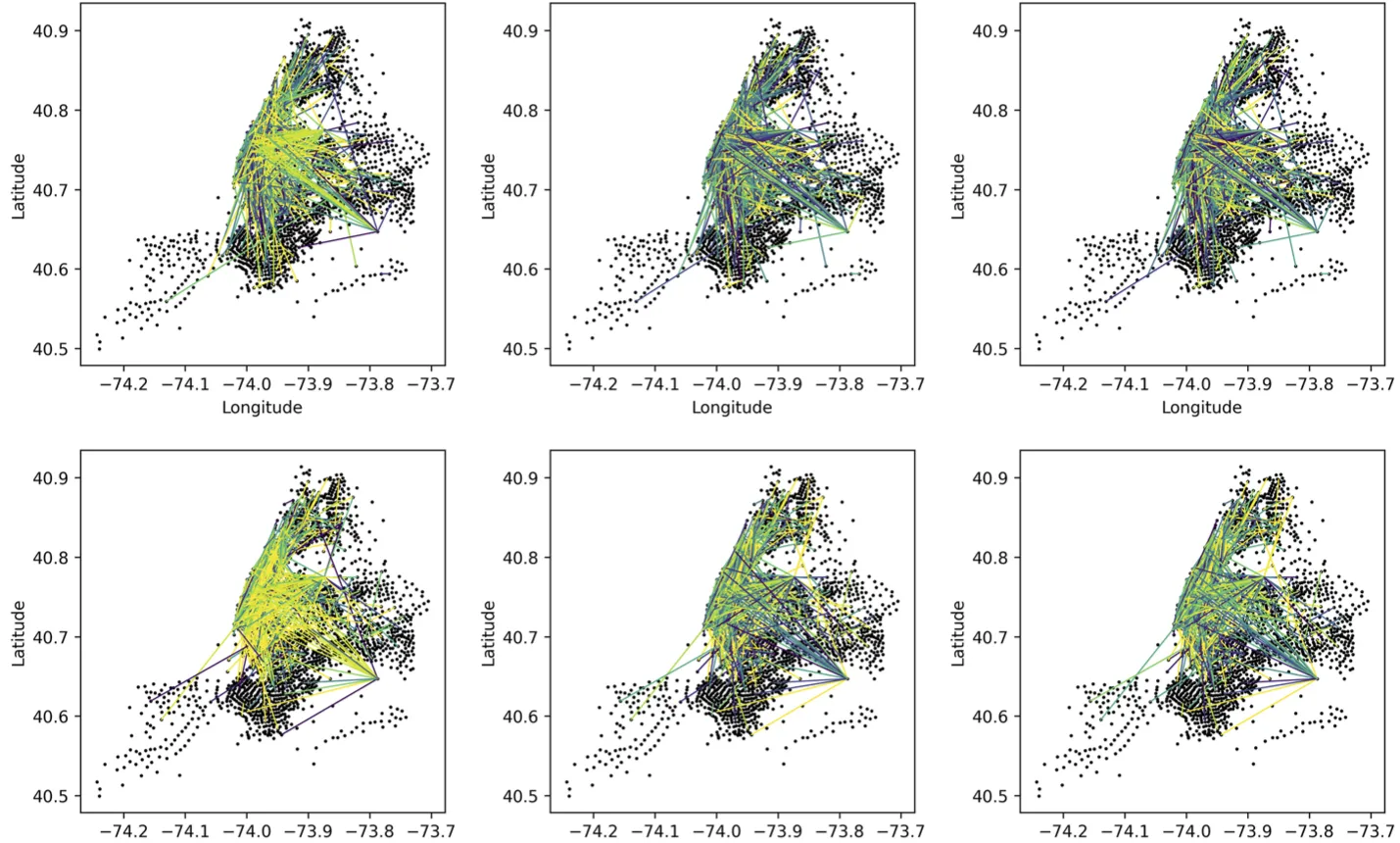
We develop a Bayesian deep learning model that not only predicts origin-destination flows from geographic features, but also quantifies the epistemic uncertainty of these predictions and identifies key drivers of mobility. Applied to large-scale NYC taxi data, our approach enhances the interpretability and reliability of AI-based planning tools.
Aike Steentoft, Bu-Sung Lee and Markus Schläpfer, Quantifying the uncertainty of mobility flow predictions using Gaussian processes. Transportation 51, 2301–2322 (2024) [link].
Markus Schläpfer, Lei Dong, Kevin O’Keeffe, Paolo Santi, Michael Szell, Hadrien Salat, Samuel Anklesaria, Mohammad Vazifeh, Carlo Ratti and Geoffrey B. West, The Universal Visitation Law of Human Mobility, Nature 593, 522–527 (2021). [link]