Urban intensification and infrastructure efficiency
We develop a deep, scientific understanding of how people make use of urban space and use these insights to make infrastructures more efficient and resilient.
Highlights:
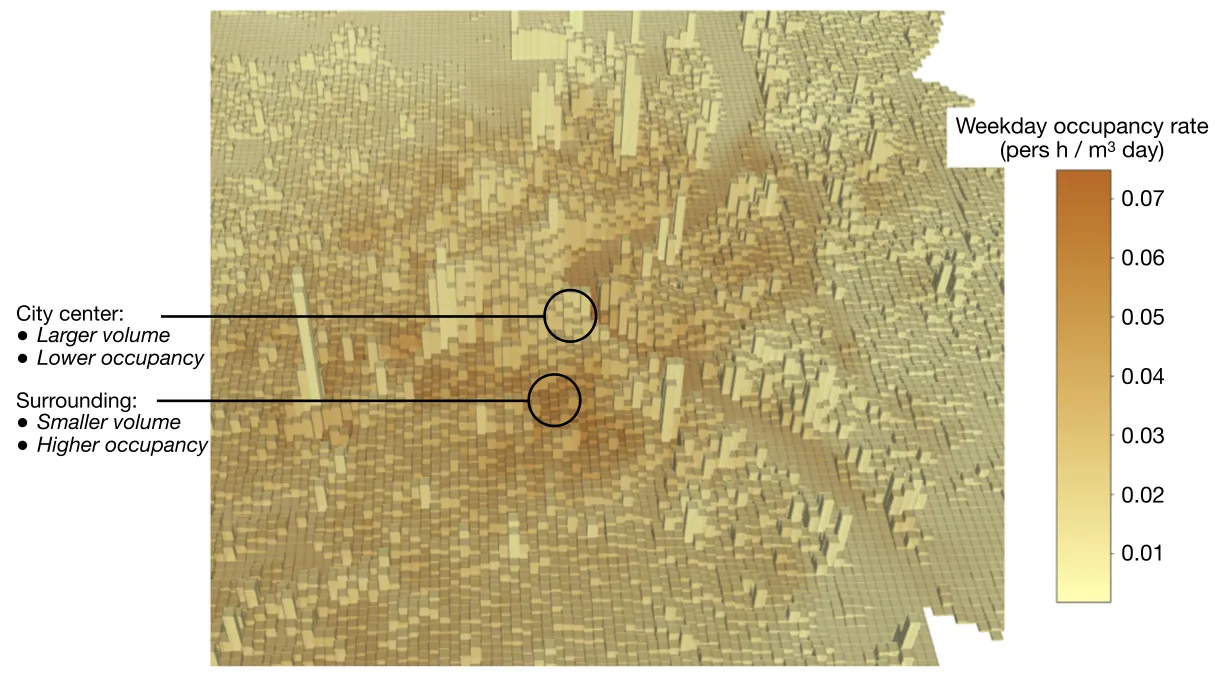
In light of climate change, resource scarcity, and population growth, it becomes increasingly important to use the existing built-up space of our cities efficiently. However, the degree to which the available three-dimensional (3D) urban space is actually being utilized by human activities has never been studied systematically at a high spatial and temporal resolution. In this work, we explore the space-use efficiency across 20 major French cities, measured by the dynamic occupancy rates of their volumes. The occupancies (number of people present) are predicted by a random forest model trained on fine-grained mobile data traffic, while the urban volumes are derived from 3D city models. The results show a surprisingly common ‘donut-like’ organization of cities, where the space occupancy is low in the city center, becomes high in the immediate surroundings, and then low again in the suburbs. This hitherto hidden regularity is associated with the distribution of urban amenities and reveals a potential to increase the utilization of under-used spaces.
Yuehan Yang, Zhexuan Tan and Markus Schläpfer, Assessing the space-use efficiency of French cities by coupling city volumes with mobile data traffic. Sustainable Cities and Society 124, 106292 (2025). [link]