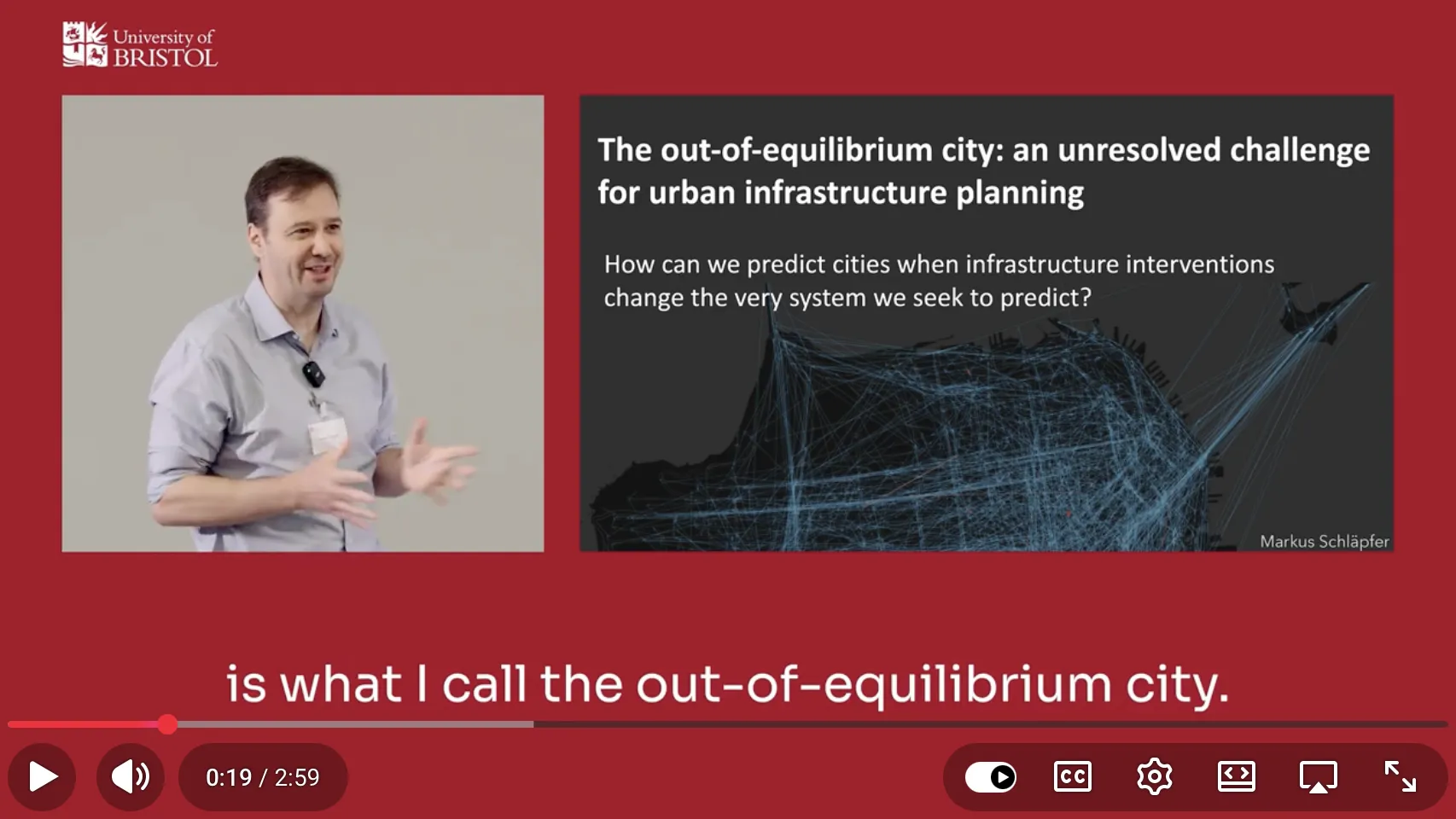
How can we predict the way cities reorganize after major interventions, when those interventions change the very system we seek to predict? Markus Schläpfer was an invited speaker at Unsolved Problems in Urban Science, the launch symposium of the Planetary Urban Sciences Lab (+Lab) at the University of Bristol, where he set out the challenge of the Out-of-Equilibrium City: urban science can now forecast mobility, traffic and energy demand with increasing accuracy, but it does so from observations of a city in its current state — while the decisions that matter most to infrastructure planners, from new metro lines to congestion pricing to pedestrianization, are precisely the ones that change that state. Such interventions do not simply shift travel times; they reshape land use, economic activity and social interaction, and with them the behavior we were trying to model. Developing a framework for how people, firms and institutions co-adapt after major infrastructure interventions is one of the central challenges for the next generation of urban science.
Watch the talk.