Active Research Projects
Predicting mobility flows with urban science and artificial intelligence
Human mobility is not only at the heart of the economic functioning of cities, but it also shapes the demand for infrastructure services. Our goal is to understand and predict people's city-wide mobility patterns and how they affect and are affected by changes in urban infrastructures. To achieve this goal, we combine urban science with artificial intelligence.
Mobility-informed infrastructure planning
The demand for infrastructure like transportation, energy, and water highly depends on the spatial and temporal presence of people. Our research uses high-resolution, dynamic mobility flow predictions to improve infrastructure demand forecasts - particularly for energy systems. This enables both real-time operational support and long-term planning, particularly under stress conditions such as extreme heat.
Recent Publication
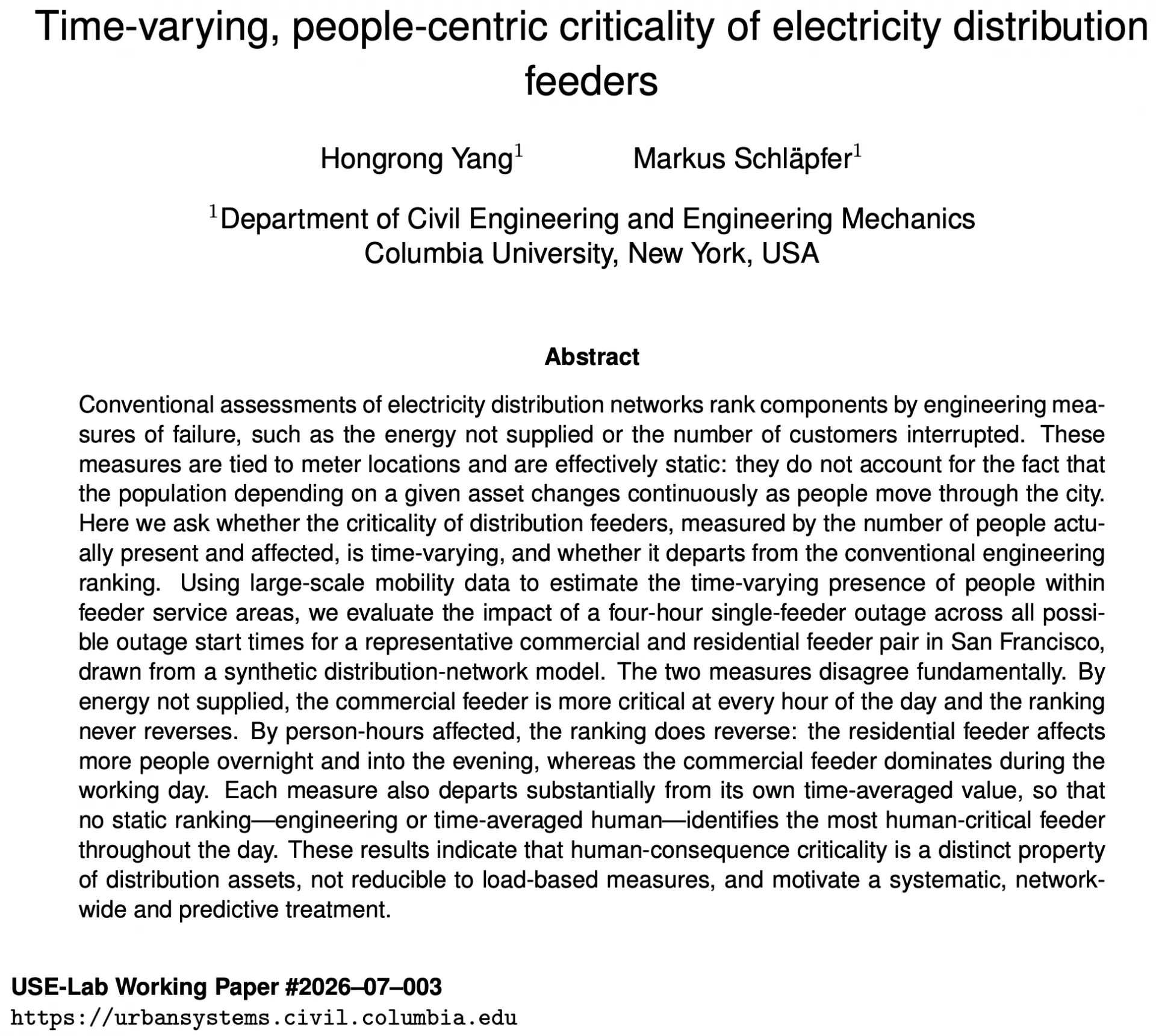
Time-varying, people-centric criticality of electricity distribution feeders
News
New paper published in Computers, Environment and Urban Systems
Using optimal transport theory and mobility data from Singapore’s MRT system, we show that urban travel patterns are shaped more by the collective decisions of travelers than by centrally optimized routing, emphasizing the role of self-organization in the design of efficient and people-centric transit systems.
The Out-of-Equilibrium City — invited talk at the +Lab launch symposium, University of Bristol
Markus Schläpfer introduced the Out-of-Equilibrium City — the problem that our predictions of urban life rest on observing cities as they are, while the infrastructure decisions that matter most are the ones that deliberately change them.
Columbia Engineering highlights Nature Communications paper
Our recent paper in Nature Communications on electric vehicle charging and photovoltaic integration in tropical cities was featured by Columbia Engineering. The study shows how decentralized charging strategies can substantially increase the amount of solar energy that cities can integrate while reducing stress on the electrical grid.